
Direct answer: To track body recomposition, record both inputs and outcomes: completed strength workouts, sets and key lifts, food intake against calorie and macro targets, weight as a trend, and periodic measurements or photos under consistent conditions. Review several weeks together; no single scale reading, workout or image can show the whole change.
What a body recomposition tracker should show
Body recomposition usually describes trying to change the balance of fat mass and lean mass rather than pursuing scale weight alone. Consumer measurements cannot perfectly isolate those tissues, so useful tracking relies on multiple signals. Your training and food logs show the behaviors you can act on. Weight, key lifts, circumference measurements and photos show different parts of the outcome, each with its own noise and limitations.
This is why a dashboard should help you review trends, not declare success from one reading. NIDDK recommends following progress with tools that record food, physical activity and weight, and advises recording weight changes over time. See its evidence-reviewed guidance on eating, activity and weight. Resistance training is one part of the picture: federal guidance recommends adults perform muscle-strengthening activity involving all major muscle groups on two or more days each week.
A practical body recomposition tracking method
-
Choose a consistent review window
Decide in advance that you will evaluate a block of several weeks rather than one day. Daily body weight and gym performance can move for many reasons. A fixed review date reduces the temptation to rewrite the plan whenever one signal changes.
-
Track training completion and performance
Schedule repeatable strength sessions and record exercise variations, sets, reps and weight. Completion shows adherence; repeated exercise records show what your training performance is doing. Key-lift trends are useful context, but one unusually strong or weak day is not the trend.
-
Log food against a starting target
Record meals, quantities, calories and macros consistently enough to understand the pattern. Treat calculated targets as estimates, not precise requirements. Overall food quality and individual needs still matter, and a food log is only as complete as the information entered.
-
Record weight consistently
If weighing is appropriate for you, use the same scale and similar conditions. Focus on the direction across multiple readings. Salt intake, hydration, digestion and other factors can change short-term weight without representing a comparable change in body tissue.
-
Add periodic measurements or photos
Use the same measurement location and technique. For photos, keep lighting, distance, pose and clothing as consistent as practical. These records add context when scale weight changes little, but they are still imperfect and should not become a daily judgment.
-
Make one measured adjustment
At review time, first ask whether the records are complete enough to interpret. Then compare training consistency, food logging, key lifts, weight trend and any periodic measurements. If a change is warranted, adjust one part of the routine and set the next review date.
Use each signal for the right question
| Signal | Useful question | Common limitation |
|---|---|---|
| Workout completion | Did I follow the plan? | Completion does not measure exercise quality |
| Sets and key lifts | How is repeatable performance changing? | Exercise variations and daily readiness affect results |
| Calories and macros | What intake did I record? | Portion and food data may be incomplete |
| Weight trend | What direction is body mass taking? | Short-term fluctuations are normal |
| Measurements or photos | Is another body-progress signal changing? | Technique, lighting and timing add noise |
How to use IGN8 as a body recomposition tracker
Choose body recomposition as the plan goal, then create or adopt a weekly workout schedule. Log sets, reps, weight and rest during training. In the food diary, organize entries by meal and compare recorded calories, protein, carbohydrate and fat with editable targets. Home keeps the workout and nutrition sides visible on the same day.
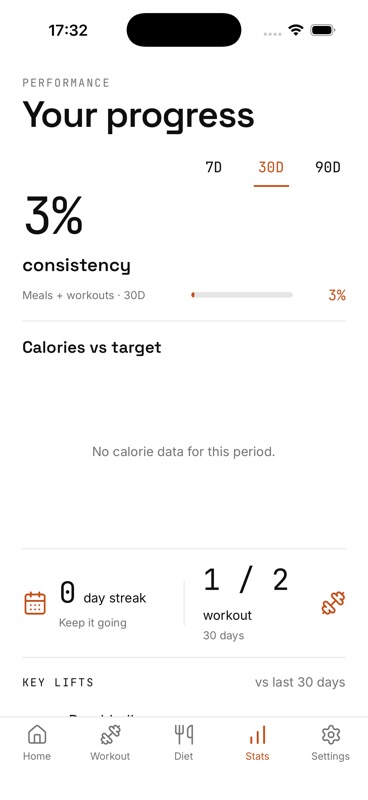
Use Log Progress to record weight, chest, waist, left and right biceps, left and right thighs, notes and a progress photo. Then review 7-, 30- or 90-day Stats views for consistency, calorie reporting, workout completion, streaks, key lifts and weight trends. IGN8 records progress photos and measurements, but it does not currently present a before-and-after photo timeline or body-measurement charts.
How to run a calm progress review
Begin with adherence, because missing data limits every other conclusion. If planned workouts were rarely completed or meals were mostly unlogged, the next step may be making the routine easier to follow rather than changing targets. If records are reasonably consistent, compare the direction of weight, measurements, photos and repeatable gym performance.
Signals will not always agree. That does not mean one is “wrong”; they measure different things and contain different noise. Extend the observation window when appropriate, check measurement consistency and avoid turning a small fluctuation into a large intervention.
Sources and further reading
See the whole routine
Connect the plan, the diary and the trend
IGN8 is pre-launch. Join the waitlist for launch news and early-access updates.