
Direct answer: To build a gym workout plan, start with the days you can train consistently, choose a structure that covers the major muscle groups, select a small set of repeatable exercises, define sets and rep targets, and record each session. Review completion and performance before adding more work or complexity.
The best plan fits your week
A custom workout planner should begin with constraints, not exercise selection. Decide how many days you can protect even during a busy week, how long each session can last, what equipment you reliably have and which movements are appropriate for you. A three-day plan completed most weeks gives you better feedback than a five-day plan repeatedly cut in half.
That practical approach matches the American College of Sports Medicine’s 2026 resistance-training guidance: regular participation matters more for most healthy adults than chasing a complicated “perfect” program, and plans should be individualized for goals, enjoyment and safety. Read the ACSM resistance-training update. For general health, the Physical Activity Guidelines for Americans recommend muscle-strengthening activity involving all major muscle groups on at least two days per week.
Build your gym plan in six steps
-
Write down the goal
Choose a primary direction such as general strength, muscle building, body recomposition or maintaining a regular gym habit. A goal helps you decide what to measure, but it does not need a dramatic deadline. If you have sport-specific or rehabilitation needs, use a qualified coach or clinician rather than a generic template.
-
Choose two to five realistic training days
Mark the actual weekdays and a backup option. More days are not automatically better. Each added day creates another appointment to keep and another session to recover from. New or returning trainees can begin with fewer sessions and build gradually.
-
Pick a weekly structure
Full-body sessions can distribute work across fewer days. Upper/lower or movement-based splits can spread sessions across more days. The label matters less than covering the muscles you intend to train, leaving recovery time and making the schedule repeatable. Our workout split planner guide compares common options.
-
Select a compact exercise list
For each session, choose movements that fit your equipment and ability. Include the major movement patterns your plan needs, then add accessories only when they serve the goal. Keep the exercise variation consistent enough to compare performance from one exposure to the next.
-
Define the work before you arrive
Give each exercise a target number of working sets and a repetition or duration range. Include rest guidance where it helps you keep sessions moving. These are planning targets, not a demand to finish a set with unsafe technique.
-
Log, review and revise
Record sets, reps, weight and any context that changes the comparison. After several sessions, review adherence and performance. Simplify a plan that repeatedly runs over time; adjust an exercise that does not suit you; progress training demand gradually when the record and technique support it.
Choose the schedule before the split
| Available days | Simple starting structure | Planning priority |
|---|---|---|
| 2 days | Two full-body sessions | Cover the major muscle groups in both sessions |
| 3 days | Full body, or rotating upper/lower sessions | Leave room between demanding sessions |
| 4 days | Upper/lower repeated | Balance work across the week |
| 5 days | More specialized split | Keep each day focused and recoverable |
These are examples, not universal prescriptions. Training history, exercise selection, set volume, other activity, sleep, health and preference all affect what you can recover from.
How to build a gym workout plan in IGN8
Open the Workout area and either adopt a plan template or create your own. IGN8’s custom plan builder supports selecting two to six weekdays and assigning a reusable workout to each chosen day. Plan goals include weight loss, muscle building, body recomposition and strength; they label your intent but do not generate an adaptive AI program.
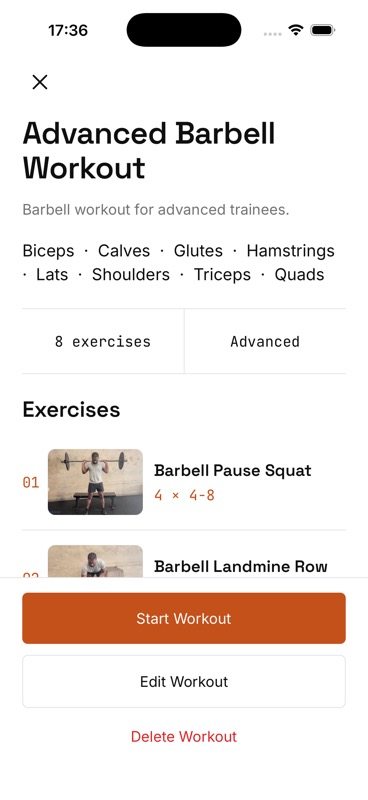
Build each workout from exercises, sets and target repetitions, then use the read-only detail to check the order, muscle focus, difficulty and planned work before training. During an active workout, log weight and reps or duration, complete sets and use the rest timer. The completed record gives you something concrete to review instead of relying on memory.
What to review after the first two weeks
First check completion: did the chosen days survive your normal schedule? Next check duration: could you finish without rushing? Then look at the log for repeated exercises. Stable or improving work with repeatable technique is useful information; a constantly changing exercise list is harder to evaluate. If sessions are too long, remove low-priority work before adding another day.
Do not rewrite the whole plan after one poor workout. Travel, sleep, stress, equipment and ordinary variation can change a session. Look for a repeated issue, make one practical adjustment and let the updated plan run long enough to evaluate.
Sources and further reading
Plan it. Log it.
Build the plan—and keep the record
IGN8 is pre-launch. Join the early-access waitlist to hear when the workout planner is ready.