
Direct answer: A workout and calorie tracker works best when it connects four records: your scheduled training, completed sets, food intake and longer-term progress. Plan the week once, log sets and meals close to when they happen, then review weekly trends instead of reacting to one workout or one day of eating.
Why combine workout and calorie tracking?
Training and food are different behaviors, but they support the same goal. A gym log tells you what you planned and completed: exercises, sets, reps, weight and rest. A food diary tells you what you recorded against a calorie and macro target. Keeping both in one daily view reduces the mental handoff between separate apps and makes a weekly review easier.
The benefit is visibility, not automatic coaching. One dashboard cannot prove that a particular meal caused a good session, and an app should not make a medical decision for you. It can show whether the routine you intended is the routine you logged. The U.S. National Institute of Diabetes and Digestive and Kidney Diseases notes that smartphone trackers can help people record food, physical activity and weight and may support staying with a plan. See the NIDDK guidance on eating, activity and tracking.
A simple workout-and-food tracking system
-
Set a weekly training schedule
Choose days you can repeat for the next several weeks. Start with a realistic commitment, not an ideal week that only works when life is quiet. Current U.S. guidance recommends muscle-strengthening work involving all major muscle groups on at least two days a week for adults; your ability, experience and health may change what is appropriate. The CDC’s adult activity guide also emphasizes choosing activities that suit your abilities.
-
Choose a starting calorie and macro target
Treat any app-generated target as an estimate. Record the goal and keep it stable long enough to compare your intake and progress, unless a qualified professional has given you different instructions. Protein, carbohydrate and fat totals can add context, but they do not replace overall diet quality.
-
Log the workout as performed
Record the exact exercise variation, working sets, repetitions or duration, and load. Mark what you actually completed rather than copying the plan forward. A brief note—such as a machine change or shortened session—keeps later comparisons honest.
-
Log meals while details are fresh
Add foods to the correct meal, check the quantity and review the calorie and macro values before saving. Consistency matters more than creating a perfectly detailed diary for two days and abandoning it on the third.
-
Review patterns on a fixed cadence
Once a week, compare planned and completed workouts, calorie reporting, strength entries and weight trend. Ask one useful question: “What is the smallest change I can repeat next week?” Change one variable at a time where practical so the next review is understandable.
What to track—and when to review it
| Record | Log it | Use it to answer |
|---|---|---|
| Sets, reps and weight | During training | Did I complete the planned work? |
| Meals, calories and macros | As you eat or soon after | What did I record against my target? |
| Workout completion | At session end | How closely did my week match the plan? |
| Weight and key lifts | Consistently; review as a trend | What direction is the longer pattern taking? |
How to do this in IGN8
Start in Workout by choosing a plan template or creating a weekly plan and reusable workouts. During a session, IGN8 supports weight-and-rep or timed set logging, set completion and a rest timer. In Nutrition, add foods by breakfast, lunch, dinner or snack and compare recorded calories, protein, carbohydrate and fat with your targets.
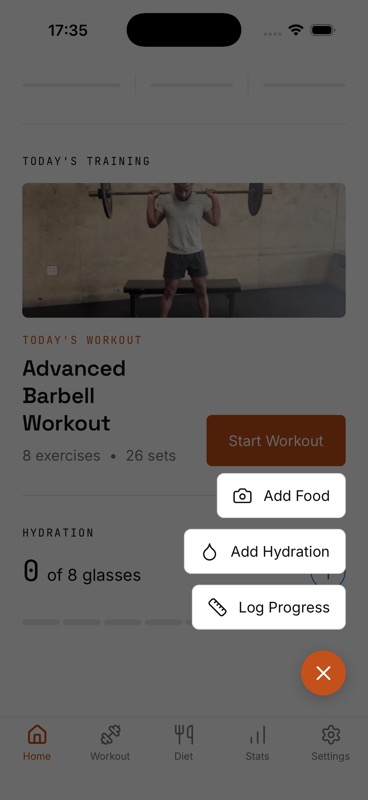
Home puts the active or next workout beside calorie and macro progress, with quick actions for food, hydration and body progress. Stats then brings calorie reporting, consistency, planned and completed workouts, streaks, key lifts and weight trends into one review area. You decide what to adjust; IGN8 does not automatically alter your training because of a nutrition entry.
A five-minute weekly review
Pick the same day each week. First, count completed workouts against planned workouts. Next, check whether your food log is complete enough to interpret—missing days are information, not a reason to invent entries. Then look at key lifts and weight as trends rather than verdicts. Finally, keep the plan, simplify it or make one measured adjustment. The goal is a repeatable feedback loop, not constant optimization.
Sources and further reading
Train. Eat. Progress.
Put the whole routine in one place
IGN8 is pre-launch. Join the early-access waitlist for launch news and product updates.