
Direct answer: Choose a workout split by starting with the number of days you can train consistently. Use three days for broad, efficient sessions; four days to divide work cleanly; or five days only when shorter, more frequent sessions fit your schedule and recovery. The best split covers your intended muscle groups and survives an ordinary week.
A split is a calendar, not a result
A workout split simply distributes training across the week. “Upper/lower,” “full body” and “push/pull/legs” describe organization; the label does not tell you whether exercise selection, set volume, effort or progression is appropriate. Start with availability, then use the split to make each day clear and manageable.
For healthy adults, the CDC summarizes the federal guideline as muscle-strengthening activity on at least two days each week, alongside aerobic activity recommendations. ACSM’s 2026 resistance-training update emphasizes training all major muscle groups at least twice weekly and says consistency matters more than complex programming for most adults. It also recommends individualizing a plan for goals, enjoyment and safety. See the official ACSM guidance.
Compare common workout split options
| Days | Example structure | Works well when | Watch for |
|---|---|---|---|
| 3 days | Full body each day, or alternating full-body sessions | You need fewer weekly appointments | Sessions becoming too long |
| 4 days | Upper / lower / upper / lower | You want a clear, balanced division | Back-to-back days that repeat demanding work |
| 5 days | Upper / lower plus push / pull / legs | Shorter sessions fit your week better | Extra attendance without useful added work |
These structures are examples rather than prescriptions. A three-day full-body plan can be demanding; a five-day plan can use modest sessions. Exercise choice, sets, effort, other sport and your training history determine the actual workload.
Choose your split in five steps
-
Audit the next four ordinary weeks
Count the sessions you could keep during work, study, family and travel commitments—not just the coming week. If three days are reliable and a fourth is occasional, build a three-day base rather than a four-day plan with a permanent missing session.
-
Place the days on the calendar
Choose exact weekdays and identify a backup day where possible. Avoid bunching similar demanding sessions together unless your plan intentionally accounts for it. Calendar placement often eliminates an attractive split that does not fit your life.
-
Check training coverage
Map the major muscle groups and movement patterns across the week. A split should prevent accidental gaps, not create them. If one missed day removes an entire area for the week, decide whether a more distributed structure would be more resilient.
-
Fit the work into the available time
Estimate exercises, working sets and rest rather than only counting movements. If your three-day sessions routinely exceed the time available, a fourth shorter day may help. If five days create unnecessary travel and setup time, fewer consolidated sessions may be better.
-
Run the split before optimizing it
Use the schedule for several weeks, log completion and review repeated exercises. Change the split when the calendar repeatedly fails, session length is impractical or recovery is consistently inadequate—not simply because another routine looks more advanced.
Three sample calendars
3-day: full-body rhythm
Monday, Wednesday and Friday can provide a rest day between sessions. Each workout covers the plan broadly, with exercise variations or emphasis changing across days. This can suit someone who wants fewer gym visits and can manage moderately longer sessions.
4-day: upper/lower repeat
Monday upper, Tuesday lower, Thursday upper and Friday lower creates a clear division and a midweek break. It makes exercise reuse and like-for-like logging straightforward. Other day combinations can work; the point is a repeatable pattern.
5-day: more frequent, focused sessions
A five-day structure can distribute work into shorter sessions, but it should solve a real scheduling or programming need. If attendance falls, do not compress every missed exercise into the weekend. Return to the plan or rebuild it around fewer reliable days.
How to build a workout split in IGN8
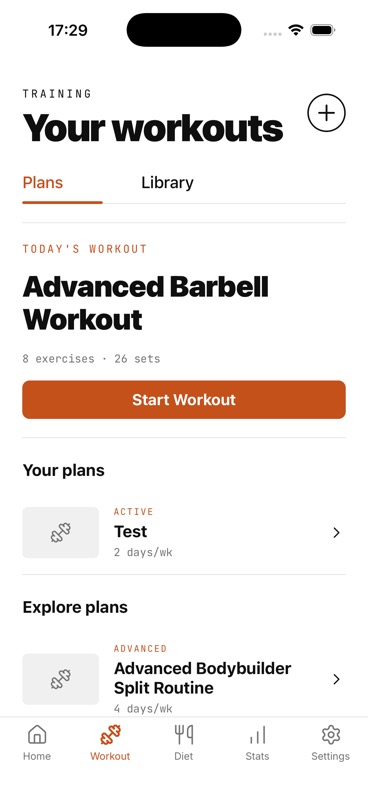
In Workout, choose a plan template or create a custom plan. IGN8’s plan builder supports two to six selected weekdays. Assign a reusable workout to each chosen day, then open each workout to check exercises, target muscle groups, sets and rep ranges before the week begins.
During training, log completed sets, reps, weight or duration and use the rest timer. Home shows the active or next workout, while Stats shows planned and completed sessions, workout streak and frequency. That makes it possible to test whether your chosen split fits your actual week. IGN8 does not automatically generate or adapt a split with AI.
When to change the split
Change the calendar when you repeatedly miss the same day, sessions exceed the time you have, or the distribution no longer matches your goal. Before adding a day, ask whether it will redistribute existing work or simply add more. Before removing a day, decide where essential exercises move. Preserve the exercise records that remain comparable so the new schedule does not erase your training history.
Sources and further reading
Make the week visible
Build a split you can actually follow
IGN8 is pre-launch. Join the waitlist for launch news and early-access updates.